Welcome to WordPress. This is your first post. Edit or delete it, then start writing!
Blog
-
Giving thanks – on PFAS
You really can make a difference
This news update is part of a series on PFAS (per- and polyfluorinated alkyl substances, “Forever Chemicals”) in drinking water. You can read all the previous posts here.
It’s Thanksgiving week here in the USA. This year, I’m giving thanks to my friends from PFAS-affected communities across the state, at our environmental non-profits, and at the EPA and the State Departments of Ecology and Health, for the following pieces of good news that I have to share about PFAS in my home state and further afield.
First, Washington State Department of Ecology has quietly released a PFAS Statewide Funding Strategy: Four-Year Plan for Prevention, Reduction, and Mitigation in Washington State.

In March this year, we reported on this Funding for PFAS, including on a letter to Ecology that several of us from PFAS-affected communities cosigned with Toxic-Free Future and other environmental organizations. In June this year, several signatories of the letter met with the director of Ecology to discuss this further.
In case you think that you can’t make a difference, here’s a direct quote from the Funding Strategy Document:
In March 2024, Ecology received a comment letter from a coalition of environmental advocates, including Toxic-Free Future, Zero Waste Washington, and Puget Soundkeeper Alliance, among others. In June 2024, Ecology representatives met with Washington residents affected by PFAS in drinking water. In both cases, the strategy was modified to account for information received.
The Strategy document is 88 pages long. I’ll be back with a more complete review in due course. For now, I’ll point out that it addresses two concerns: that state agency staff often operate in silos and that a coordinated approach is needed; and that funding is similarly fractured into multiple programs that can both overlap and leave gaps, and that a centralized funding source is needed. Both are music to my ears.
The funding still needs to make it through the legislature in a tough budget year. I’m here to help.
Secondly, following the June meeting with the Director of Ecology, I sent a letter to the EPA Region 10 Administrator and to the Ecology Director asking the EPA to help Ecology with testing private wells for PFAS around rural fire stations on Whidbey Island and elsewhere. A flurry of emails resulted in a meeting between me, EPA, Ecology, and Health, resulting in an agreement to set up a pilot study, probably here on Whidbey, to test private wells and smaller water systems around one of the water systems that has tested positive.
I’ve since learned that the pilot study may be expanded, with the funding above, into a statewide prioritized testing program, while EPA Region 10 is looking at rolling out something similar throughout the region, so in Alaska, Idaho and Oregon in addition to Washington. More what I have it, probably in the new year.
Happy Thanksgiving to those who celebrate!
Thanks, as always, for listening or reading. Next week we’re leaving for New Zealand for the month of December. I expect to have plenty to write about!
The work described in this post took me many hours. If you value this work and feel moved to support it, a paid subscription to Mostly Water is a great way to do that, and of course I’m always grateful for your comments, likes, and shares.
-
Island County Comprehensive Plan Climate Resiliency Sub Element
Over the last two weeks, Island County Planning Department held a series on three Stakeholder Workshops to discuss the Climate Resiliency Sub Element for the Comprehensive Plan. Stakeholders from a variety of organizations and industries were invited to participate in the workshops, including environmental groups, builders, tribes, social services, NAS Whidbey, and economic development. The public was invited to listen in and observe the workshops; there will be a chance for the public to provide written comments to inform the process. Randi Perry and John Lovie represented Whidbey Island Water Systems Association at these workshops.
Watch the recordings of the Climate Workshops below:
Now is your opportunity to add your comments. Scroll through the Island County Climate Element Resiliency Explorer StoryMap to learn more about the Climate Element work done to date. Then head to the public engagement page Island County 2045 – Planning for Our Future | Engage Island County, take a look at the comments already submitted under climate, and “like” them if you agree. You can go on to add your own comments.
-
A Gray Tsunami
Further adventures in water system consolidation
I didn’t get to write to you last week, as I was at a conference and otherwise immersed in water system concerns. This, week I get to tell you all about it. Writing this newsletter keeps me honest. Mostly Water subscribers are represented in each of the groups of people—state and county staff, commissioners, neighboring water systems, and others—with whom I work and whom I write about. Just as in our island community, where most of us behave in traffic because that might be our neighbor we just flipped off, I have nowhere to hide. I think of you, my subscribers, as my accountability partners. If you’re reading and are not among them, here’s a button to become a subscriber. If you feel moved to support my work, which is otherwise unpaid, there’s a paid option.
This post is about community. OK, on a technical level, it’s about drinking water system problems against a backdrop of climate change, but the solutions don’t happen without community. If you didn’t catch it when it came out, you could read “You might want to move your wells” as an introduction to this piece, as well as for the why.
Because control of a common pool resource like drinking water should remain in public hands; because running a public water system is one of the few remaining areas of life where people from different political and social backgrounds must work together for the common good; and because building trust, relationships, and community is the point.
This month, I found myself on a stakeholder panel for a series of three workshops on the Climate Resiliency Sub Element of the Comprehensive Plan, required by the State Department of Commerce as part of the county’s comprehensive plan update. The first workshop was on sea level rise. For a primer on the sea level rise issues our island is facing, you can read An Imperfect Storm.
In short, Island County is home to half of the most at-risk beach front properties in Puget Sound. There is no state-wide or sound-wide plan to deal with them. It’s left to the counties. King County, home to Bellevue and Seattle, has property tax revenue from Microsoft, Amazon, Costco, and Boeing that they can use to buy out these properties in the county’s Vashon Island. Island County, however, relies on property taxes from those same companies’ executives’ 6000-square-foot beach front mansions, and is hardly in a position to do the same. Those hanging on to family beach cabins in between the mansions are left both high and dry, and low and wet. Shoreline public infrastructure and natural habit seem destined to become collateral damage. Beach front property owners were conspicuous by their absence among the invited stakeholders.
What’s needed is a community conversation about the future. As Elizabeth Rush shows in Rising: Dispatches from the New American Shore, solutions work better when the community is involved in crafting them. What will the beach look like in 10, 20, 50 years, and how do we get there from here? It’s not happening. People see few options other than to defend their properties with armor. Their views easily follow. If government can’t position itself as part of the solution, it’s going to be seen as part of the problem. Sea level rise comes back to bite us in the consolidation discussion further down.
Following the sea level rise workshop, I headed out Wenatchee in central Washington for a conference on funding for infrastructure projects. As part of the consolidation effort, we’ve been working with the group from the Department of Commerce whose conference this was. It was wonderful to meet in person so many I’d only met on zoom calls or through phone or email.
There’s talk in the water business of a gray tsunami. Usually said in the context of the wave of retirements of baby boomer generation water system operators, it’s equally true of the volunteer boards than run many of them, and increasingly of their physical infrastructure – the wells, pumps, and distribution systems.
Thanks to the Bipartisan Infrastructure Law, there’s a once in a generation funding bonanza right now that has the potential to address these issues and save the day. The problem is the lack of pipelines and programs to get that money to where it’s needed. The federal government has sent that money to the states, but the state agencies and counties are used to operating in an environment of scarcity, and don’t have systems in place to handle abundance. Without someone at the front line pulling on the other end, they are pushing on a rope. The pulling falls to those aging and tired board members who are being asked to build a water system for a future they may never see. Encouraging and cajoling them into action falls to a few volunteer champions, for whom it can quickly become a full-time unpaid job. Yes, that’s me over here, planting sequoias.
“Invest in the millennium. Plant sequoias. Say that your main crop is the forest that you did not plant, that you will not live to harvest.”
— Wendell Berry
I had a sobering conversation and an inspirational conversation during the week. At the breakfast table one morning were the staff of a small Eastern Washington City, both of them. He’s the public works department – everything from dog catcher to sewage treatment plant operator. She’s the city clerk. She’s paid minimum wage. She lives on the reservation, 32 miles out of town. She spends $100 a week on gas, and needs a new set of tires every year. One day a week, then, she’s working just to pay for her car. Washington Initiative 2117 would cancel the state’s Climate Commitment Act and with it part of the gas tax. I’m going to vote no on I2117, but I must do so knowing that it’s going to hurt this lady much more than it hurts me. I must also remember that it’s her tax dollars that are paying for the Bipartisan Infrastructure Law. We have a duty to her to spend that money wisely.
I also met the mayor of small town in Eastern Washington, one of two devastated by wildfires in 2020. These were not forest fires. The towns are in the Palouse, the rolling dryland wheat country best known to those of those of us of a certain age from this beloved Windows 95 wallpaper.

One hot, dry, day in the summer of 2020, a spark from a combine harvester set fire to a wheat field, and gusty winds blew the flames into the town of Lind. That same wind blew a branch into a power line in Malden, resulting in a fire that destroyed 85% of the town’s buildings. Meanwhile, the relentless march eastwards of irrigated alfalfa for dairies and export is displacing dryland wheat and pulling down the water table under these towns so much that their wells are now thousands of feet deep and are pulling up warm, salty water. Despite the same age challenges that we face here, these towns are meeting with each other and with the farmers to hammer out solutions.
Since I wrote “You might want to move your wells”, our engineer completed the consolidation study discussed there and recommended that we consolidate with our neighboring water system and relocate away from threats associated with development and sea level rise. The State Office of Drinking Water approved the report, but went further and suggested that we consider extending the consolidation to include other neighboring water systems, an idea that makes a lot of sense but is, of course, even harder to do.
Initial casual conversations with those neighboring systems revealed a level of interest in pursuing this further. There are issues with water rights and land use that are complex enough to earn a dedicated post at some point.
Here’s sea level rise coming back to bite us. All of our neighboring water system’s connections and almost half of ours are on the most at-risk beach in the most at-risk county in Puget Sound. Two thirds of those members are second homeowners here and only drink the water a few weekends a year. They may be reluctant to invest in a water system for the ages when the existing ones may be good enough to outlast their homes. We’re going to need a plan that works for everyone. It may not be one-size-fits-all.
Thanks as always for reading or listening. If you’d like to support this work, a like, share, or subscription is a great way to do that.
-
A PFAS Sandwich
Two slices of good news with a bad news filling
This news update is part of a series on PFAS (per- and polyfluorinated alkyl substances, “Forever Chemicals”) in drinking water. You can read all the previous posts here.
At the end of the last update, we were left with three open issues: the Military’s response to the EPA’s new National Drinking Water Standard for PFAS; lawsuits challenging that standard; and testing of private wells with non-military sources of PFAS contamination. The last few months have brought us positive developments on two of these, and negative on the other. I’ll slide the bad news in between two slices of good.
The Military
The DoD released a memo on September 3rd outlining a policy for prioritization of cleanup actions to implement the EPA’s new National Drinking Water Standard. You can read the whole memo here. Here are some of the key passages:
To ensure cleanup begins as quickly as possible, the DoD Components will initiate removal actions to address private drinking water wells impacted by PFAS from DoD activities where concentrations are known to be at or above three times the MCL values.
This approach prioritizes action where PFAS levels from DoD releases are the highest, rather than delay action at these locations while ongoing remedial investigations continue.
DoD will then initiate remedial actions to address drinking water wells and public water systems with concentrations below three times the MCL value.
The DoD Components will consider in prioritized order: providing connections to public water systems; installing whole house treatment systems; providing point of use treatment systems; and providing bottled water.
The Military Departments will ensure that robust communication occurs before, during, and after actions are taken to address PFAS on and around DoD installations.
Overall, I feel this is a reasonable approach. Given the logistical impossibility of doing everything all at once, prioritization makes sense. Each service — Army, Navy, and Airforce — will now have to figure out how to implement this policy at each base, and how to set up public outreach. I’ll be following how this goes, particularly around our local military PFAS site, Naval Air Station Whidbey. It hasn’t happened yet.
Before this memo, the DoD was still working with outdated and much higher EPA lifetime health advisory limits, now recognized as not being protective of human health. Under this new policy, many more people will have their drinking water tested and will be offered remediation.
We’ll put this one in the good news column, the bottom slice of bread in our sandwich.
The lawsuits
In June, the American Water Works Association (AWWA) and the Association of Metropolitan Water Agencies (AMWA) filed a petition with the U.S. Court of Appeals for the District of Columbia Circuit to review U.S. EPA’s Final PFAS Drinking Water Rule. The National Association of Manufacturers and American Chemistry Council filed a similar petition, as did PFAS manufacturer Chemours.
These three petitions have now been consolidated into one, which you can read here. The title page now reads:
AMERICAN WATER WORKS ASSOCIATION, et al., Petitioners,
v.
UNITED STATES ENVIRONMENTAL PROTECTION AGENCY, et al., Respondents,
AWWA is the headline, while the polluters are hiding among the et al. In other words, the companies, towns, and cities responsible for providing you with safe drinking water are now carrying water for the very people who are polluting it, all while consuming the lion’s share of the grant and low-cost loan money available for remediation and leaving little to nothing in the coffers for the mostly rural Americans drinking from small water systems and private wells.
Digging into the weeds just a little, there are four arguments in the petition. The first three are objecting to the EPA’s use of a Hazard Index to regulate several PFAS compounds on the basis of their cumulative, rather than individual, concentrations. The fourth challenges the EPA’s cost-benefit analysis of the new limits for PFOS and PFOA, the two PFAS compounds with the most well documented health effects. If there’s a silver lining, it’s that they’re accepting that PFAS compounds are harmful and need to be removed from drinking water; they’re just haggling over the price.
The brief asks the court to send the rule back to the EPA for revision. Ominously, a recent addition to the list of cases referenced in the petitioners’ brief is Loper Bright v. Raimondo, the name of the Supreme Court case that overturned the Chevron Deference, the precedent that allows Congress to delegate the detailed rulemaking on new laws to federal agency experts. Safe drinking water is on the ballot in November.
This mess is the filling in our PFAS sandwich.
PFAS testing in private wells
Let’s finish on some better news.
Back in March, in Wrong Side of the Road, I reported that the response to PFAS contamination from non-military sources is a geographic lottery. Private wells on one side Highway 20 here on the island, with PFAS contamination from a Navy base, were getting testing and remediation while those on the other side with PFAS from a rural fire station were getting nothing. The EPA had stepped in to help in around Spokane International Airport, the other side of the road from Fairchild Airforce Base.
Where we left it last time was that I’d sent a letter to the EPA Region 10 Administrator and to the Ecology Director asking the EPA to help Ecology with testing private wells for PFAS around rural fire stations on Whidbey Island and elsewhere as they are doing around Spokane International Airport. A flurry of emails ensued, many of which referenced the grant programs available. Unfortunately, the grants are not working. They’re mostly only available to Local Health Jurisdictions, which in rural Washington are usually the counties, who don’t have the time or staff to even apply for the grant, let alone spend the money. Two Ecology grants that could have helped will not even be funded for the next biennium.
With grants eliminated as a possible solution, we were able to move on to a meeting. That finally happened last Friday, with EPA, Ecology, Health, and me. I was able to make the case that the agencies needed to take direct action and that a prioritization like the DoD’s, mentioned above, could make the task manageable. After some discussion, the Departments of Health and Ecology agreed to set up a pilot study, probably here on Whidbey, to test private wells and smaller water systems around one of the water systems that has tested positive.
I’ll take that as a win, not just for safe drinking water, but for the style of trust-based activism I wrote about last week.
The emails and phone calls yielded results in part because of the months and years of relationship and trust building with individuals at these agencies, and then working to connect them to each other.
That’s the top slice of bread for our sandwich.
Sorry about the filling.
Thanks, as always, for listening or reading. The work described here took me many hours. If you value this work and feel moved to support it, a paid subscription to Mostly Water is a great way to do that.
-
“You might want to move your wells”
Adventures in Water System Consolidation
Last week, I gave a talk at the Evergreen Rural Water of Washington (ERWoW) Fall Conference in Yakima, Washington, on water system consolidation. I spent some time on the nuts and bolts, but more on the community issues that so often derail these efforts. While this post is nominally about drinking water, one of my special interests, there are broader lessons here. It’s also about the challenges of spurring community action to protect and enhance a common pool resource against a backdrop of rugged individualism and private property rights. I’ll illustrate with my own community’s journey.

Two Liquid Streams Pouring into Water, by Paul Taylor Like shoveling the driveway while it’s still snowing
Water system consolidation is a merger, the combining of two or more community drinking water systems into one. It’s a particularly hot topic in Washington, because we have so many water systems, about thirty-six thousand the last time I checked. In my county, population about eight-eight thousand, we have over four hundred Group A community water systems serving at least fifteen households, seven hundred and fifty Group B systems serving three to fifteen households, and about six thousand two-party or single household wells. Seventy-two percent of the county population is served by one of these groundwater systems, meaning that we have a well for every seven people on groundwater!
The county is adding several hundred more wells each year as people move to our rural zones in search of a little house on the prairie or a cabin in the woods, each with its own well and septic system. Our zoning and water rights laws make it all too easy to do that. Consolidating water systems feels at times like shoveling the driveway while it’s still snowing, or, for those who can relate, like cleaning the house while there’s still a teenager at home.
Our aquifer layers are ice-age glacial deposits, common across the northern tier of US states and in many places around the world. Our groundwater naturally contains iron, manganese, and arsenic, with latter in particular reaching levels posing a risk to health. Although we’re spared the pesticide contamination common in agricultural areas such as the Yakima Valley, chlorination. added to deal with the almost ubiquitous coliform bacteria, can react with other material in the water to generate disinfection byproducts, or DBPS. If any these contaminants are present in problematic amounts, the water must be treated to remove them, a major cost for a small system.
Man-made contamination with nitrate and other compounds from animal waste and septic effluent, with PFAS and some other compounds from firefighting and landfills, seawater intrusion into the aquifer, and seawater inundation of low-lying facilities are all hard to treat and require relocation of the well, another major expense.
Increasing contamination, regulation, development, and sea level rise are all making these problems more prevalent and harder to handle. The certified operators who run these systems are in short supply. Most are employed by service companies called Satellite Management Agencies (SMAs). Around the state, several of these SMAs have failed and others are on the brink. One of the two significant SMAs on the island has been bought by a parent company that is also the largest private owner of water systems here, putting a critical mass of systems in the hands of a distant corporate board, shareholders, and their banks.
“Remunicipalization” is a term coined in France that has gone global. From Paris to Philadelphia, Bozeman to Buenos Aires, cities, counties, and even countries are remunicipalizing their sewer and water systems — buying them back from corporate ownership. Better would be not to let water systems get into private hands in the first place.
Consolidation can reduce costs for the users and relieve pressure on the operators. It can also give water systems the scale and power to resist private ownership and keep water in public hands. If we can only get people to do it.
“You might want to move your wells”
In the early 1900s, a gold miner from Alaska bought a piece of land near the water on Useless Bay, Whidbey Island. He sold building lots along the sand spit, and the community of Sunlight Beach was born. Our gold miner hand dug a well on the spring line at the bottom of the upland to supply the homes. Over the years, duck hunting cabins became family cabins, then second homes, then first homes.

Sunlight Beach 1872 
Sunlight Beach 2019 For historical reasons, the community has two water systems. One family, let’s call them the Montagues, was putting so much water on the back forty for the horses that the Capulets down the street weren’t getting any, so they started their own water system. Juliet was really into horses and started hanging around with Romeo. Those two are still living happily ever after, but the water systems remained estranged.
Both water systems have wells at the low end of a sloping field. In 2013, the owners of the field, descendants of the original gold miner, listed it for sale with a total of forty-eight building lots. Shortly after the sign went up, our State Office of Drinking Water engineer stopped by to inspect our facilities. He looked at the sign, looked at the wells, looked at me, and said “You might want to move your wells.”

The original listing text, courtesy of the Wayback Machine What rolls downhill
We all know what rolls downhill. The concern with development upslope from our wells was nitrate and other contaminants from septic systems making its way into our rather shallow wells. According to the State Office of Drinking Water, our first line of defence was to develop a Wellhead Protection Program. Our responsibilities as a water system included a susceptibility assessment — we were pretty susceptible — and a thing called a Wellhead Protection Area (WHPA) Delineation, essentially figuring out where our water gets into the ground and how long it takes to reach our wells. For that we’d need a hydrogeologist.
A few weeks later, I went to a dance and met a hydrogeologist. This is Whidbey Island. Things like this happen all the time. He had one of his staff do a WHPA delineation, which showed that water — whether rain or septic effluent — falling or originating on the field would be in our wells within five years.
A Department of Health septic system calculator showed that forty-eight septic systems would push nitrate in the drinking water up to 16 mg/l (parts per million, or ppm). The state maximum contaminant limit is 10 mg/l. The World Health Organization prefers 2 mg/l. Nitrate can cause problems in vulnerable populations, for example blue baby syndrome.
As we’re in an area designated as a high susceptibility Critical Aquifer Recharge Area (CARA), the county would review an application to build on or subdivide the property. The county’s criteria are that the project should not increase nitrate by more than 2 mg/l or take it above 5 mg/l. However, there is no guarantee of the county’s decision.
In 2014, our water system made an offer for the property. The offer was rejected, and the listing was removed. All was quiet until 2021, when another proposed development triggered a crisis on the water system board.
Peace breaks out
Contentious meetings resulted in changes on the board. I stepped down as well. Shortly afterwards, the owners of the field announced an intention to develop the property themselves.
I had been president of Whidbey Island Water Systems Association for a number of years, and in that role, I had helped the other water system, who were members, with some planning documents, building a degree of trust with them. Sensing an opportunity, I reached out to our regional planner at the Office of Drinking Water to see if the Consolidation Feasibility Study Grant Program, which had been suspended, might be reactivated. It turned out that it would be, at a higher rate.
Following our board changes and the increase in trust, peace broke out between the water systems. The boards agreed to apply for the grant to tackle consolidation and probable relocation together. They successfully applied for the grant and hired an engineer to carry out the study. The consolidation team had two members from each water system: a scion of the Capulets, a real ex-NASA rocket scientist, a professional mediator, and me.
The Puget Sound flood of December 27th, 2022, hit many properties on the beach and brought salt water to within feet of our wells, strengthening support for their relocation.
We overcame our differences to guide the engineer through evaluating each water system separately and looking at moving them out of harm’s way individually or together.
“The risks of contamination of the groundwater wells is sufficiently credible to recommend that affirmative actions be taken to protect the water supply in the future.”
“A prudent alternative will be to pursue construction of wells at a new location that is upslope of these potential contamination risks.”
Engineer’s Consolidation Feasibility Study report
The engineer’s report confirmed a need to relocate. The cost savings in consolidating were significant. The state Department of Health put a thumb on the scale on the side of consolidation by advising us that the zero down, low interest, possibly partially forgivable Drinking Water State Revolving Fund loans would not be available if the water systems decided to go it alone.
While the report addressed all the technical and many of the financial issues, open concerns remain around governance structures and water rates for a new system. The big issue, though, is the possibility of community resistance. This is where consolidation efforts so often fail.
It’s challenging to persuade retired people whose homes may be washed away by sea level rise and who may not even be alive in twenty years to invest in water system improvements for the next fifty. We have been conditioned to reject long-term cooperation to solve major problems, if it’s presented to us as a short-term threat to our independence. Our fixation on freedom has been weaponized against us.

Building trust, relationships, and community is the point
Overcoming that kind of resistance takes time in building trust, relationships, and community, as we can only move at the speed of consent. It’s tempting to feel that it’s not worth the effort. After all, we’re adding new water systems much faster than we’re consolidating. So, what’s the point? Why bother?
Because control of a common pool resource like drinking water should remain in public hands; because running a public water system is one of the few remaining areas of life where people from different political and social backgrounds must work together for the common good; and because building trust, relationships, and community is the point. So far, it seems to be working.
Thanks, as always, for reading or listening. To make sure you don’t miss any of these posts, please consider becoming a free or paid subscriber.
-
Adventures in Water System Consolidation
Presented to ERWoW Fall Conference, August 27, 2024, Yakima Convention Center
-
Deference
A PFAS Diary
It’s been a minute since we did a PFAS (per- and polyfluoroalkyl substances or “Forever Chemicals”) in drinking water roundup. If you’d like to start at the beginning of the PFAS saga, you can find all my earlier PFAS posts in the previous roundup. Here are my diary notes since then with posts, news, and links.
March 10, 2024. In Wrong Side of the Road, we showed that the Environmental Protection Agency (EPA) had stepped in to help the Washington State Department of Ecology (Ecology) in testing private wells in the area of PFAS contamination from Spokane International Airport, who previously had not been receiving the same testing as their neighbors across the road in the area of contamination from Fairchild Airforce Base.
March 22, 2024. In Funding for PFAS, we discussed a letter that Toxic-Free Future and partners, including myself, sent to Ecology, urging the agency to put forward a plan for solving the PFAS in drinking water crisis facing Washington state, and requesting a meeting with the Director.
April 10, 2024. EPA announces the final National Primary Drinking Water Regulation (NPDWR) for six PFAS compounds. In You Can’t Get Fooled Again, we showed how EPA had to sprint to the finish line to keep these rules safe from congressional review in a potential incoming administration.
April 19, 2024. EPA action designates two widely used PFAS as hazardous substances under the Superfund law, improving transparency and accountability to clean up PFAS contamination in communities. In Discretion is the better part of designation, we showed that the EPA’s enforcement discretion in its PFAS Superfund designation will help make sure that the polluters, not the victims, pay for cleanup.

Photo by taichi nakamura on Unsplash April 26, 2024. The new drinking water rule is published in the Federal Register, with an effective date sixty days out on June 25th. The Safe Drinking Water Act requires parties challenging a regulation to file a petition within 45 days of its publication in the Federal Register, or by June 10th.
May 8, 2024. I reach out to the Department of Defense (DoD), Naval Air Station Whidbey, Fairchild Air Force Base, and Joint Base Lewis-McChord, who also look after Yakima Training Center, for their plans to comply with the new EPA Drinking Water rule. I receive responses from just the first two, both stating that DoD would issue a policy by June 24th, the day before the rule comes into affect.
May 29, 2024. EPA Region 9 issues a Unilateral Administrative Order (UAO) under the Safe Drinking Water Act to the U.S. Air Force for the Tucson International Airport Area Superfund Site to develop a water treatment plan for per- and polyfluoroalkyl substances (PFAS) for EPA’s review and approval.
June 7, 2024. The first of at least three lawsuits against the new drinking water rule is filed. The American Water Works Association (AWWA) and the Association of Metropolitan Water Agencies (AMWA) file a petition with the U.S. Court of Appeals for the District of Columbia Circuit to review U.S. EPA’s Final PFAS Drinking Water Rule.
June 10, 2024. The National Association of Manufacturers files a similar petition, as does PFAS manufacturer Chemours, as the window for such petitions closes.
June 13, 2024. The signatories of March’s letter to Ecology have our requested meeting with the Director and staff. I am able to point out that on Whidbey Island, as in Spokane, wells in areas contaminated by military sources of PFAS are getting tested but those contaminated by non-military sources are not. I request the same testing for these communities as Ecology is carrying out with EPA help around Spokane International Airport. The Director asks if have asked EPA directly. I have to say that I have not. After the meeting, I begin to research the most effective channel to do just that.
June 24, 2024. The promised DoD policy does not appear. I am assured that they are working on it.
June 25, 2024. The new drinking water rule for PFAS comes into effect
June 28, 2024. In a 6-3 ruling, split along ideological lines, the Supreme Court in the Loper Bright case overturns their own 1984 Chevron Deference decision As Substack’s own
Joyce Vance explains in Why You Should Be Concerned About Loper Bright:
The administrative state, which conservatives have spent decades attacking, has operated since the Chevron decision in 1984 on the basic premise that Congress passes laws and agencies issue regulations that implement them. What happened when a regulated entity didn’t like an agency’s decision? They could sue.
The longstanding Chevron deference doctrine required courts to defer to agency action when the law was ambiguous and the agency’s view was reasonable. That came to an end on Friday, when Chief Justice Roberts wrote for the majority in no uncertain terms, “Chevron is overruled.” After Loper Bright, it’s up to the courts. Judges need no longer defer to subject matter experts at a federal agency after the Supreme Court wrote that the experts have “no special competence” and decided courts were better suited to make these decisions.
July 8, 2024. Following up on the conversation with the Director of Ecology on June 13, I send a letter to the EPA Region 10 Administrator and to the Ecology Director asking the EPA to help Ecology with testing private wells for PFAS around rural fire stations on Whidbey Island and elsewhere as they are doing around Spokane International Airport.
July 18, 2024. Well, that didn’t take long. Just three weeks after the Supreme Court decision, the US Air Force challenges EPA’s emergency order on PFAS cleanup at Tucson Superfund Site citing Chevron Deference.
July 26, 2024. An article in the local paper mentions PFAS contamination in the Whispering Pines mobile home park’s water system here on Whidbey Island. I’ve been tracking this one. It’s just across Highway 20 from the Naval Air Station Whidbey’s Area 6 Landfill, which is known to be contaminated with PFAS and other contaminants such as dioxane. Despite pressure from the local EPA office, the Navy will not consider stepping out their areas of testing and responsibility to include communities like Whispering Pines until the DoD issues a policy decision on the new PFAS rule.
August 2, 2024. EPA Region 10 has received my letter and calls me with some clarifying questions while they work on an answer.
August 9, 2024. Another article in the paper tells that Whispering Pines decides to go ahead and fix the PFAS problem themselves with Drinking Water State Revolving Fund money.
August 12, 2024. I learn about the Air Force’s refusal to treat PFAS in drinking water around Tuscon Airport when the story hits mainstream news. I write to my DoD contact asking if this is the new PFAS policy. I receive a very apologetic answer saying they can’t respond directly and need to coordinate all media queries through DoD’s Public Affairs office. If I wish, they will work with the media office to get me an official comment. I ask for an official comment.
August 13, 2024. The Guardian reports: WHO to scrap weak PFAS drinking water guidelines after alleged corruption.
Regulations ignored credible research and didn’t fully protect human health, independent scientists say. The move follows allegations that the process of developing the figures was corrupted by industry-linked researchers aiming to undercut strict new US PFAS limits and weaken standards in the developing world.
Safe drinking water is on the ballot in November.
Well, as you can tell, a lot has happened, or, in some cases, not happened, since the last roundup, but much remains unresolved. We have more loose ends than we started with. I hope we can tie some of them up soon.
It took just three weeks for the consequences of the Supreme Court’s decision overruling the Chevron deference to be felt in undermining drinking water protections for the public. Chevron is just a foretaste of the wholesale destruction of the administrative state laid out in Project 2025.
Safe drinking water is on the ballot in November.
In the coming weeks, I’m excited and honored to have two guest essays scheduled in other publications. I’ll be sharing links to those with you. At the end of the month, I’m giving a talk on water system consolidation. I’ll tell you all about it. I promise it’s more fun than it sounds. Starting with that conference, I have four visits scheduled over the next few months to Central Washington and the Yakima and Columbia rivers. I’ll be looking at the region through a water lens and reporting back.
-
Pueblos, Acequias, and Dams
Water in Northern New Mexico
This is one of an occasional series on travel through the lens of water. Others include Swim, Bike and Run in the Coachella Valley, and The Desert is All About Water in Tucson.
We recently returned from a trip to Santa Fe and Taos Pueblo in Northern New Mexico. I was, of course, curious about the impact of water on settlement in the area.
Maia Duerr gave me a rabbit hole to go down with a Postcard about the Acequias of New Mexico. I dove in! I found some great information in an article from the wonderful New Mexico Museum of Art on History: The Politics of Water, which told me that:
New Mexico has the longest continuously traceable history of human water use in the United States.
[T]he organized manipulation of water resources in New Mexico spans back to at least 800 A.D. and the run-off collection systems of the Ancestral Pueblo people of the Four Corners region.
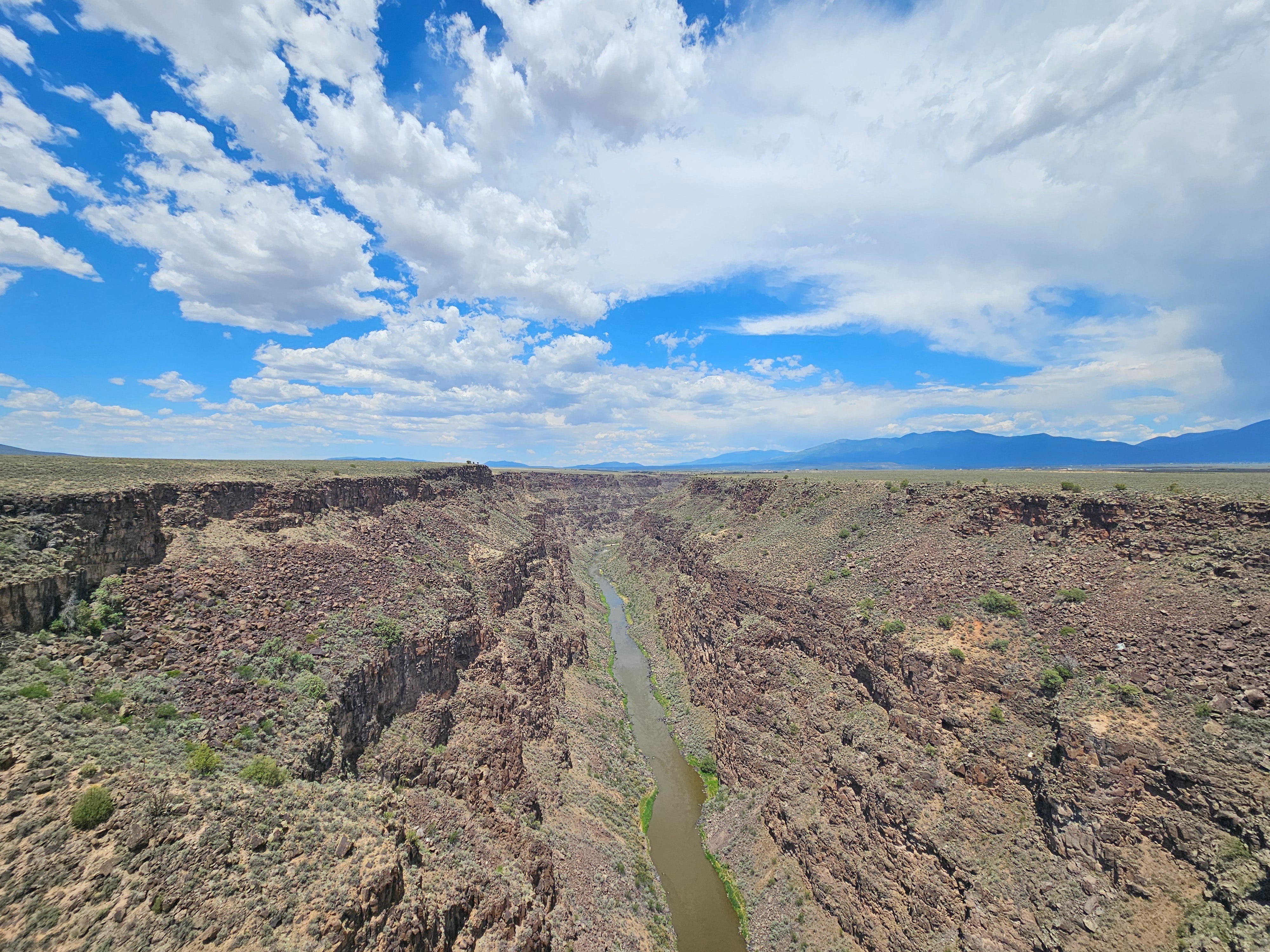
The upper Rio Grande valley is where the Rocky Mountains transition to the basin and range geography typical of the southwest, with valleys filled with layers of silt and alluvial fans. Settlements tend to be along the line where the tributaries of the Rio Grande break out of the mountain and onto the plain, rather than on the main stem, which has carved a canyon hundreds of feet deep in places, dragging the water table down with it and leaving the surrounding plateau high and dry.
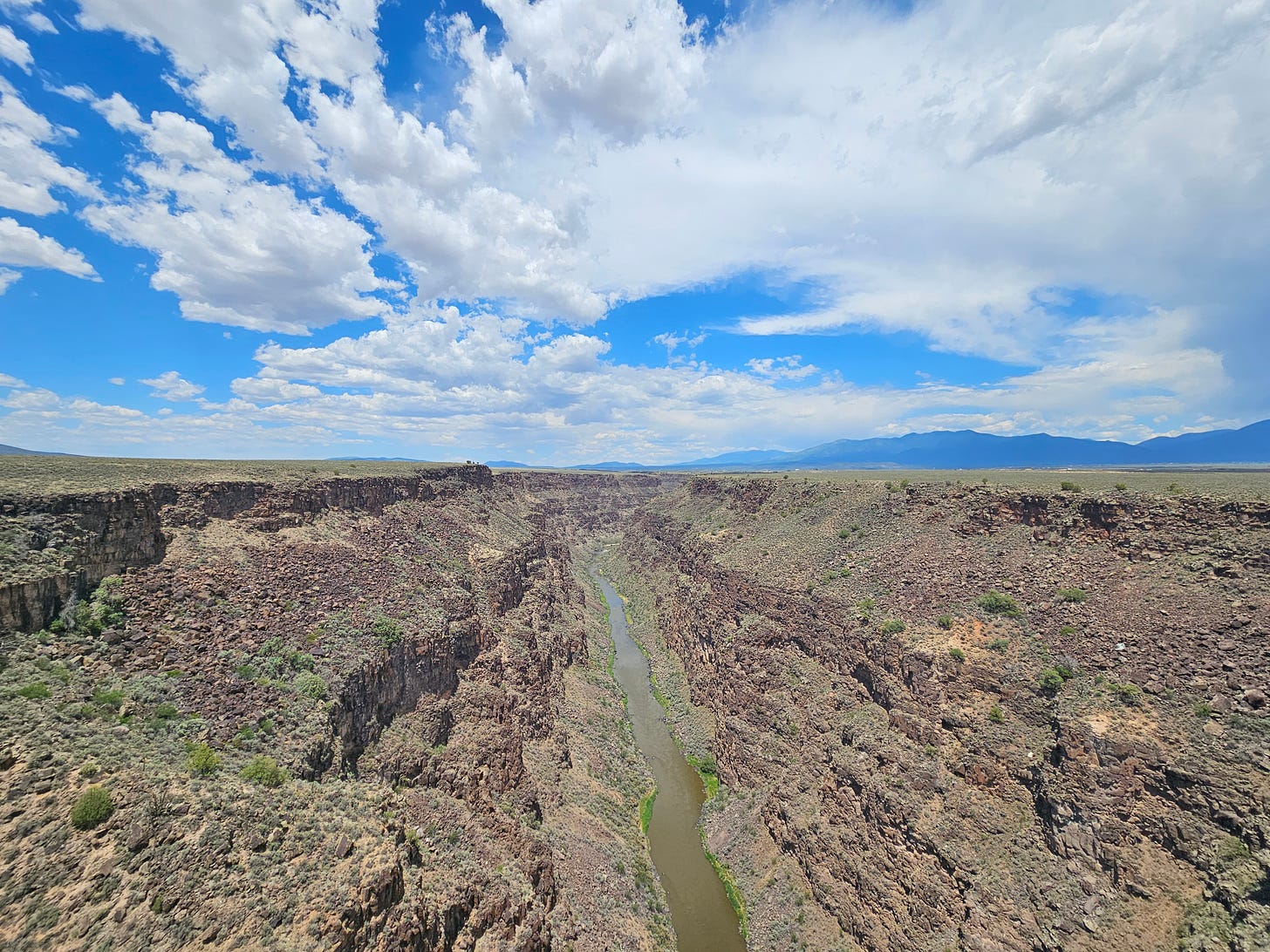
The Rio Grande 550 ft below the Gorge Bridge. Photo John Lovie Indigenous Water Use
The proximity of the mountains makes it easy to divert upstream water into irrigation ditches, and early settlements took advantage of that to grow crops of the “three sisters”, corn, beans, and squash.
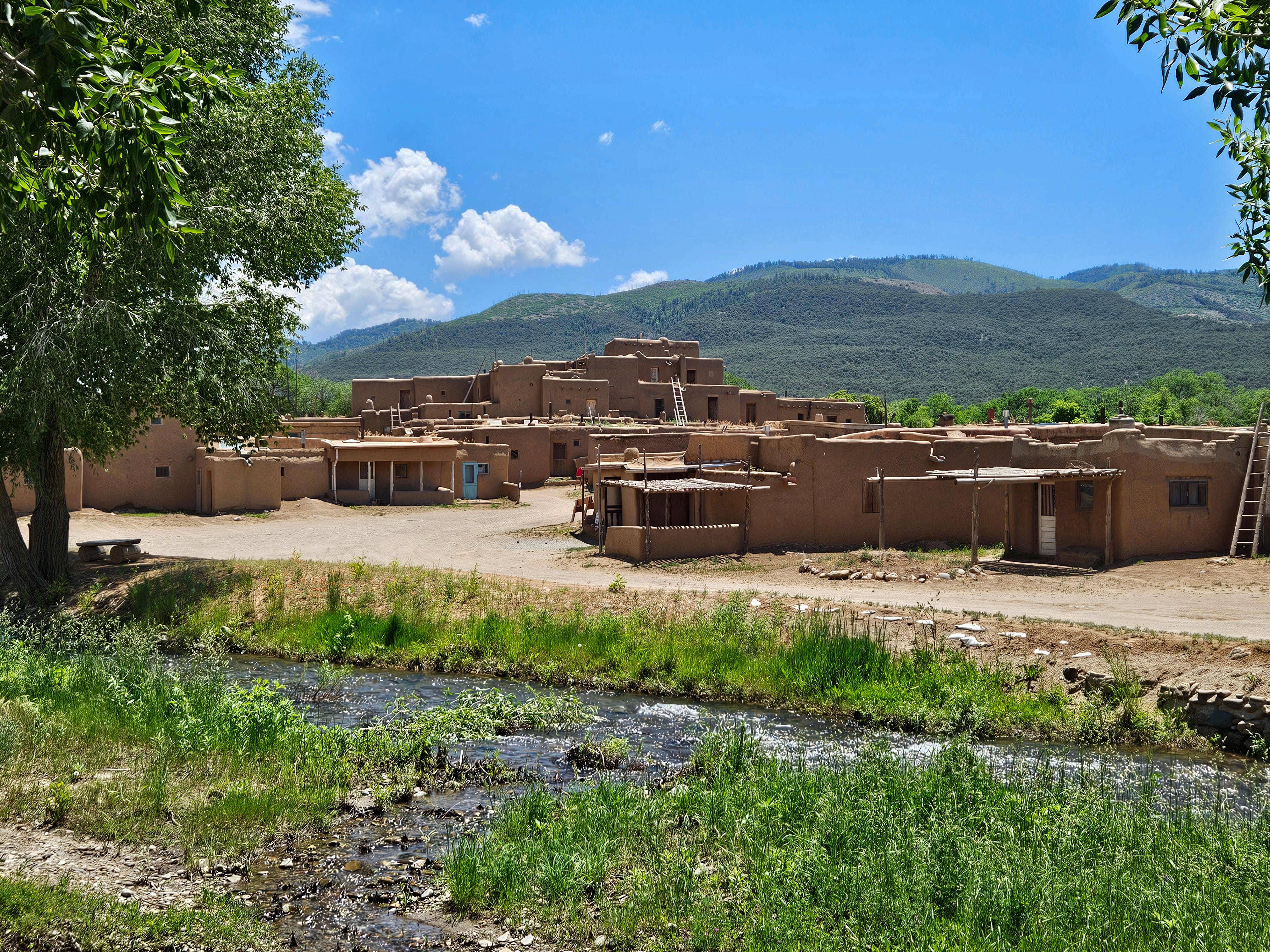
One such community is Taos Pueblo, a Unesco Heritage Site, whose adobe buildings have been continuously occupied for over 1000 years.
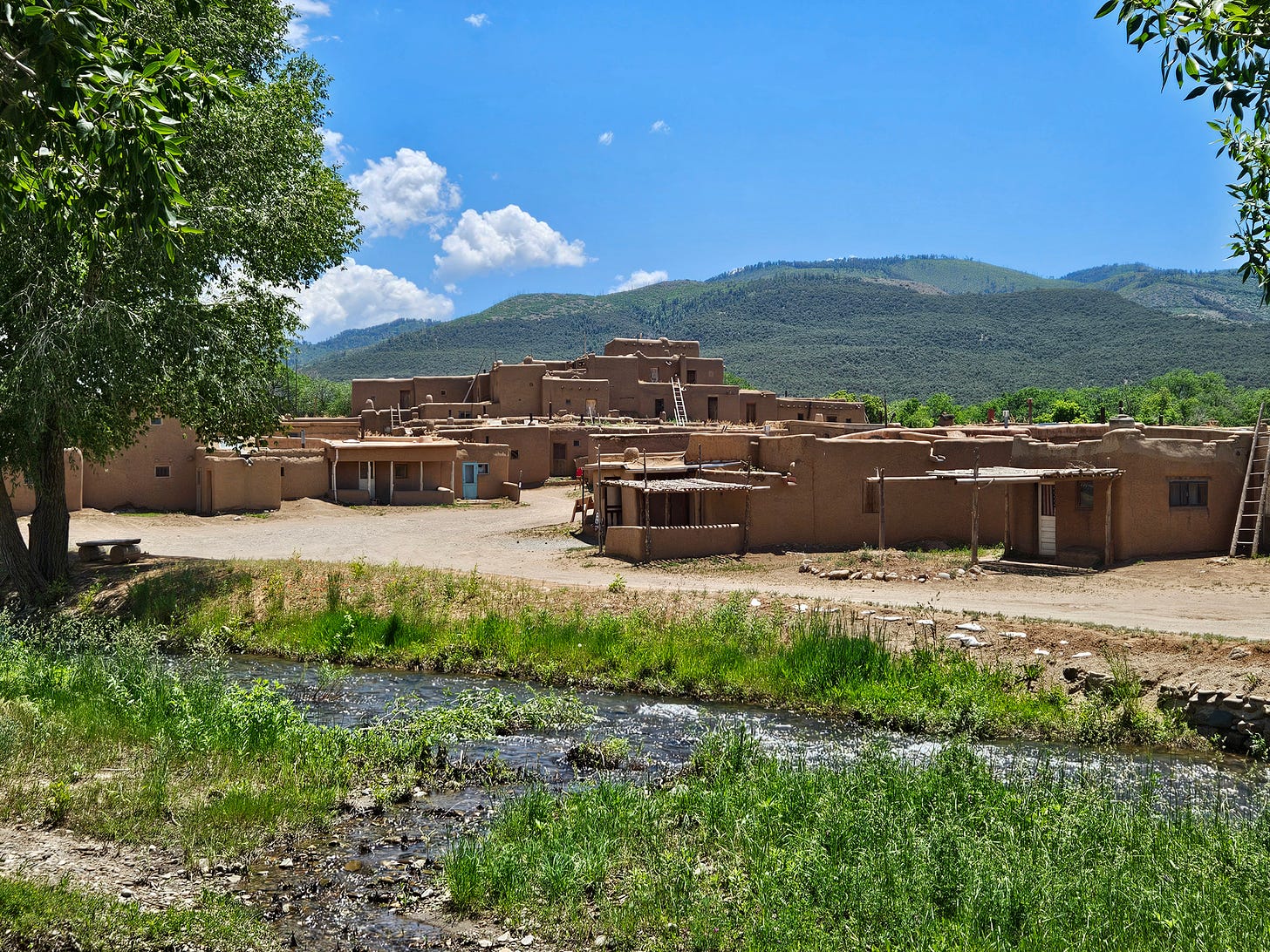
A multistory adobe building with the Rio de Taos Pueblo in the foreground. Photo John Lovie. 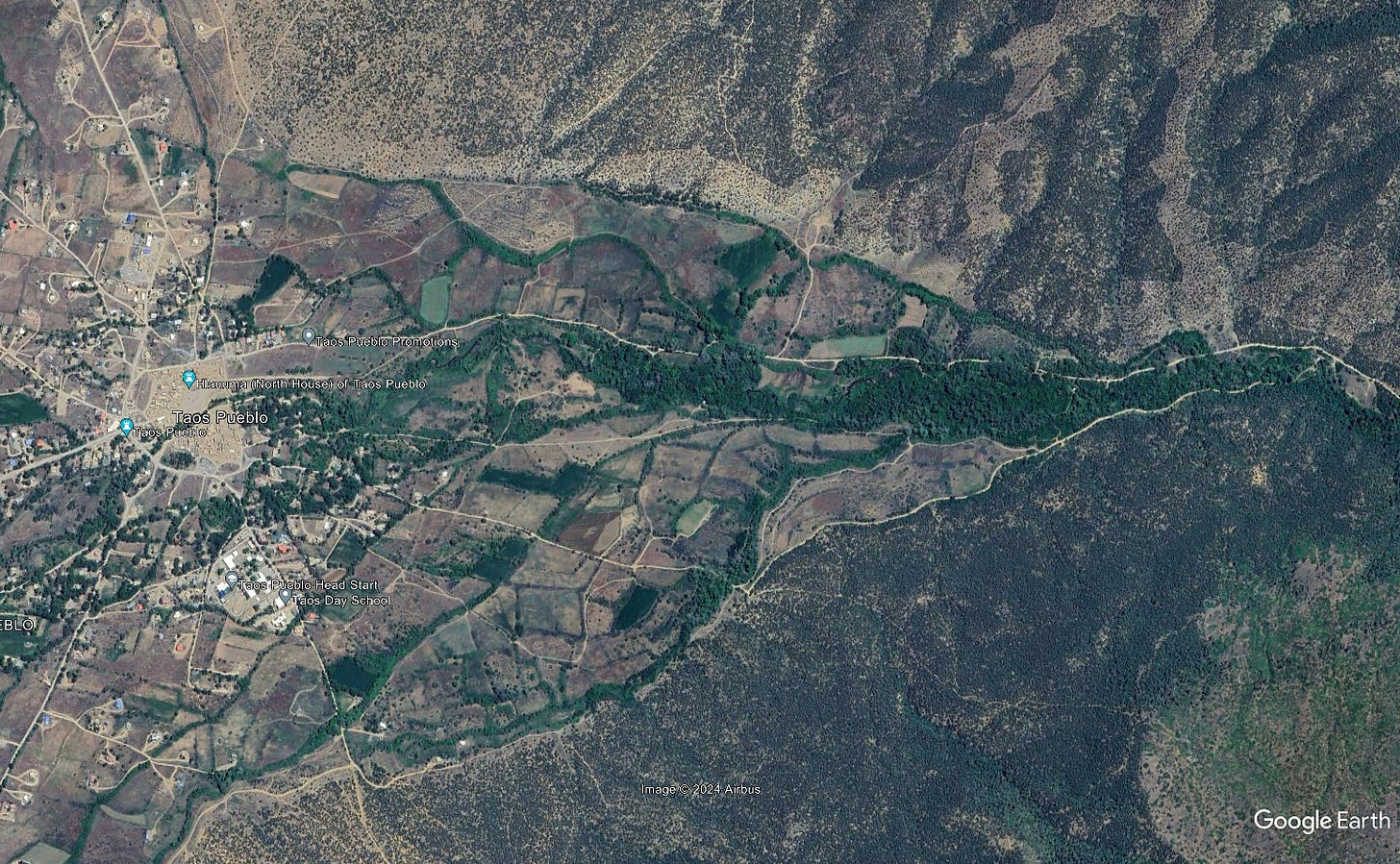
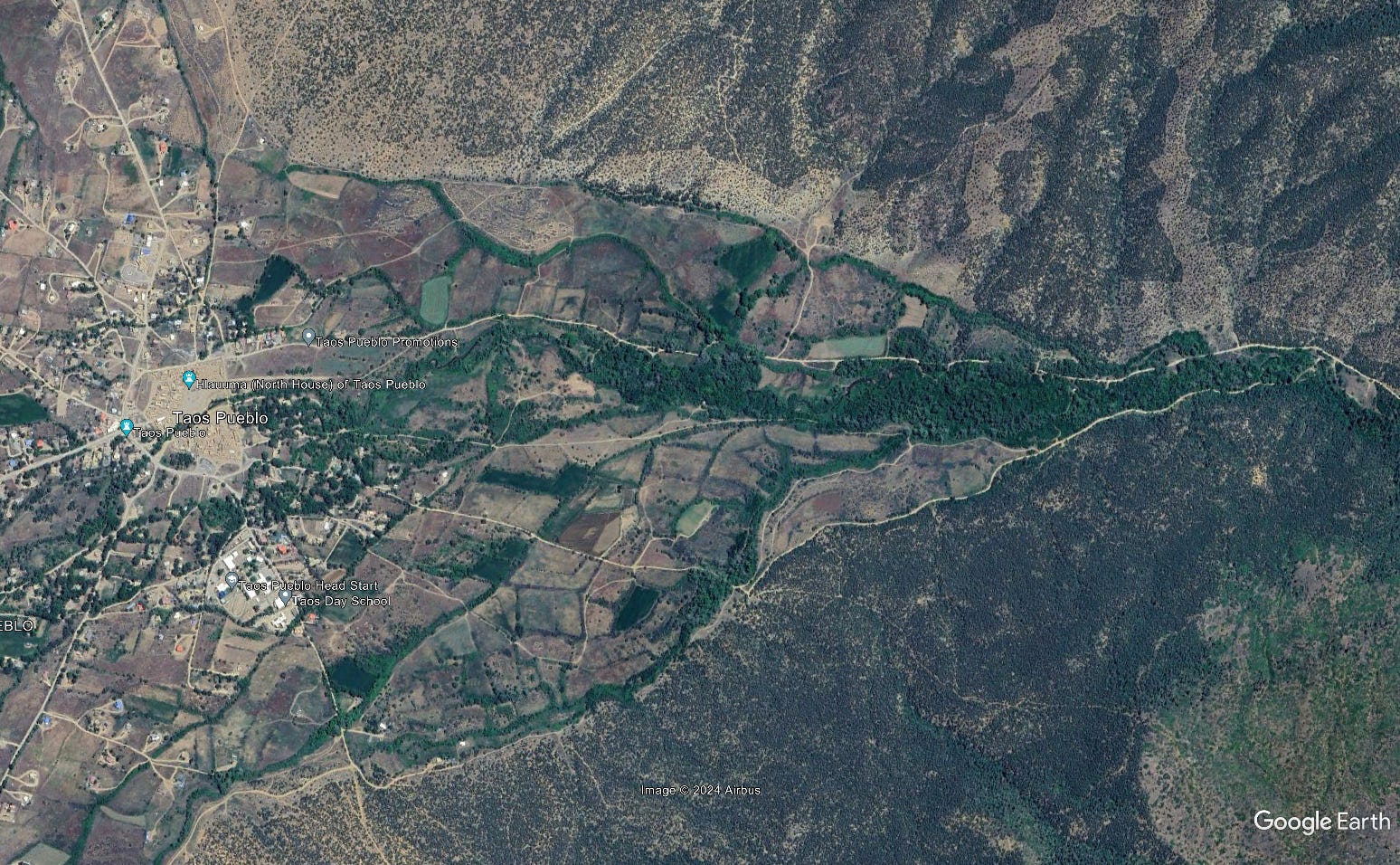
The aerial view of Taos Pueblo shows it located on an alluvial fan from the Rio de Taos Pueblo, with irrigated fields up the valley. Meanwhile in Spain
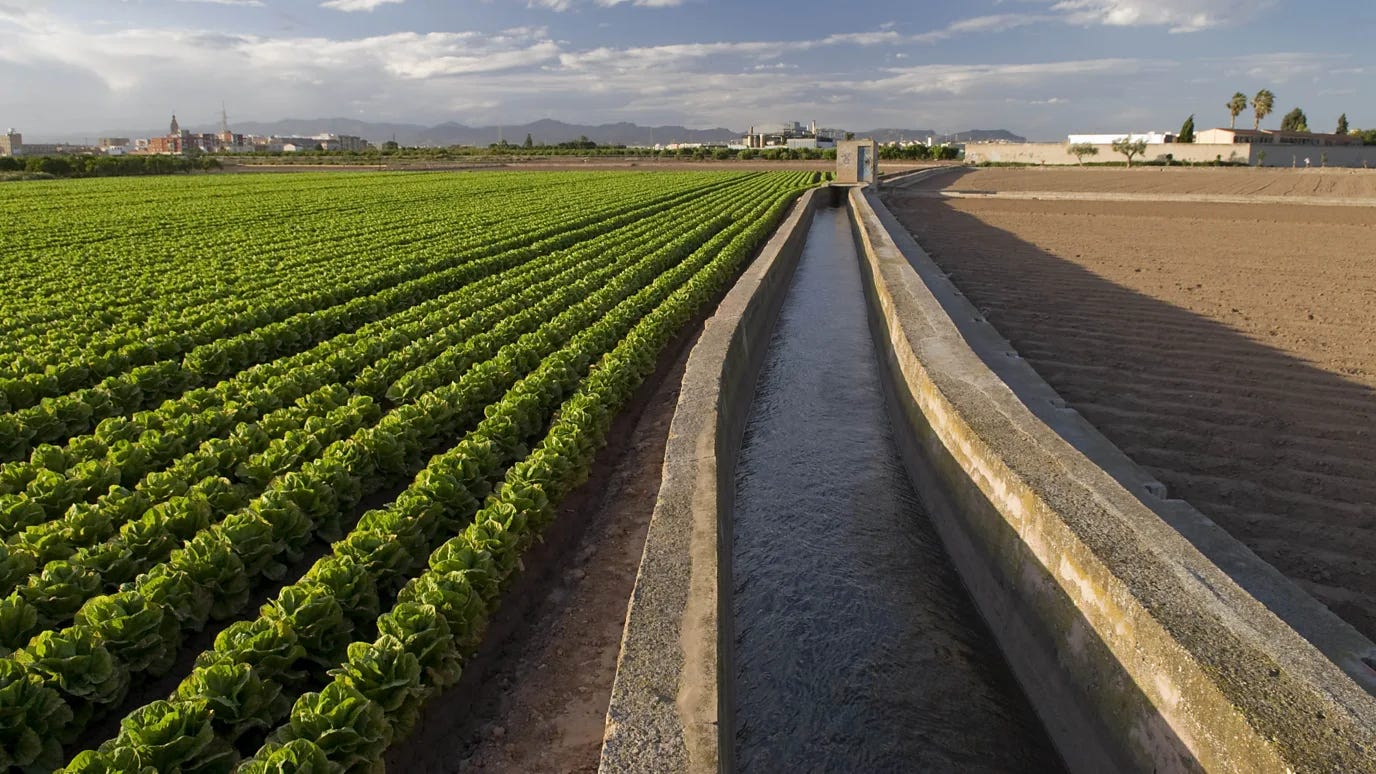
Around the time that the ancestral Pueblo people were developing irrigation systems, Moorish conquerors were introducing a similar system called acequias, a technology that had evolved and spread from Persia qanats, in use 2,000 years earlier. The irrigation systems around Valencia, for example, have endured for 1,200 years.
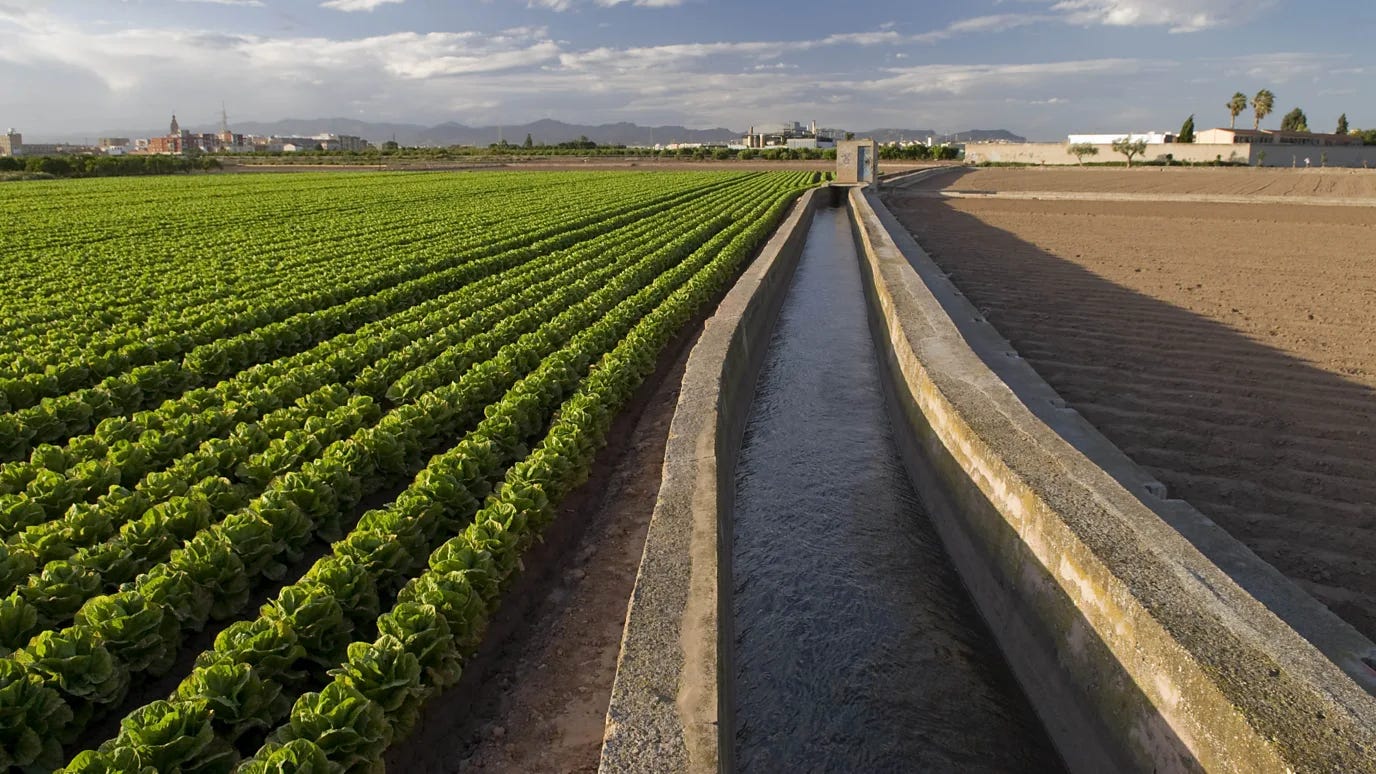
(Credit: FAO-GIAHS) According to this article from the BBC, their governance structure is just as old, and like the canals themselves, endures today.
The whole process is held together by a unique social organisation that has been governing La Huerta for more than 1,000 years. The Tribunal de las Aguas de la Vega de la València, or Water Court of the Plains of Valencia, was established around 960 CE and as such is officially the world’s oldest judicial body. The tribunal is made up of eight farmers, elected representatives of the communities that work off each of the main irrigation channels, who meet to settle disputes outside the doorway of Valencia Cathedral every Thursday at noon.
The Valencian irrigation system at La Huerta has been added by the United Nations’ Food & Agriculture Organization (FAO) to their list of Globally Important Agricultural Heritage Systems. Elinor Ostrom also featured the irrigation system and its governance structure as an example of an effectively managed common pool resource. In about 1400 AD, these irrigation systems, known locally as acequias, were introduced to New Mexico alongside the similar indigenous systems, and like them, are still in use today.
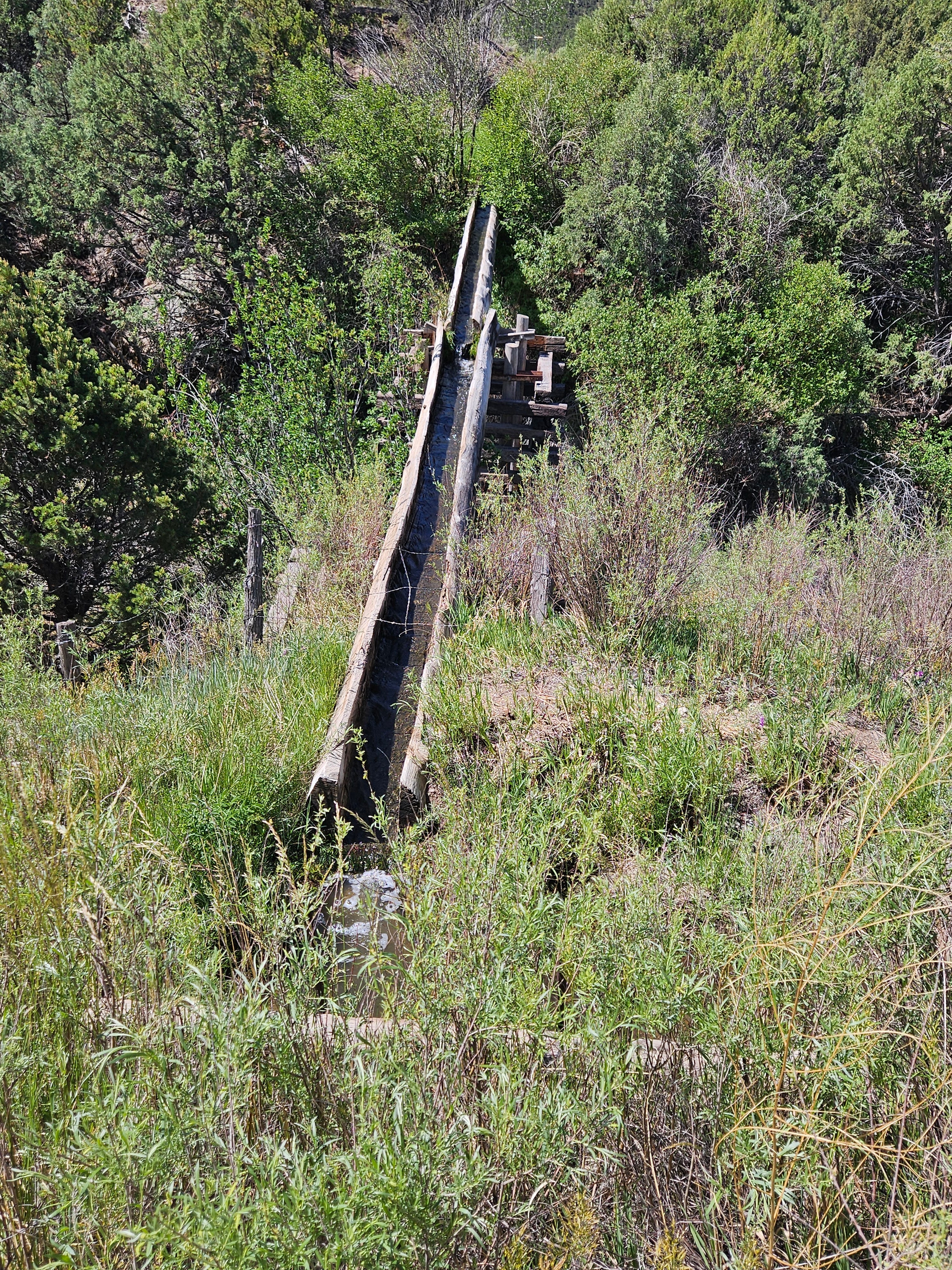
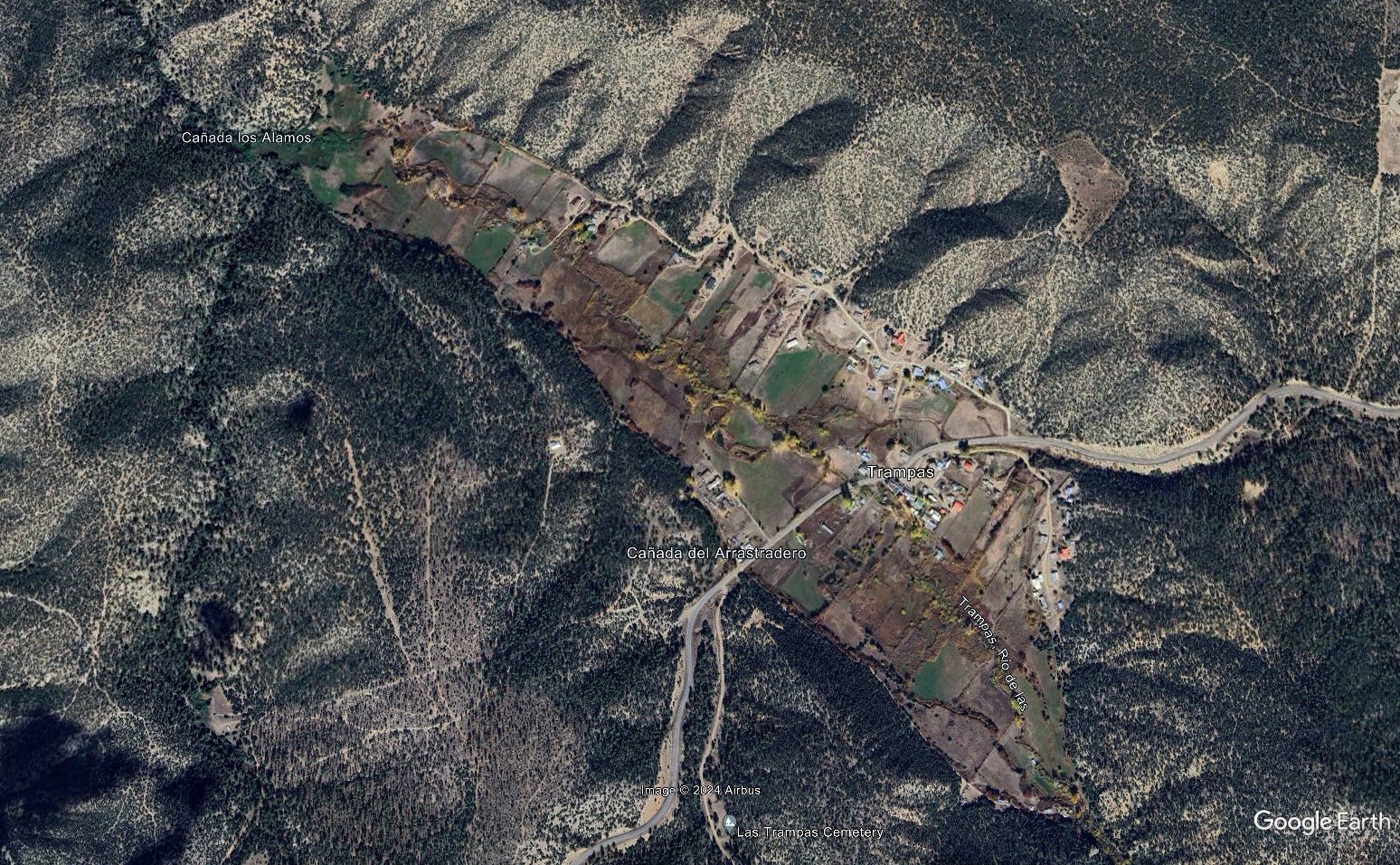
On our way from Santa Fe to Taos via the high road, we were fortunate to pass one such acequia, in the village of Las Trampas.
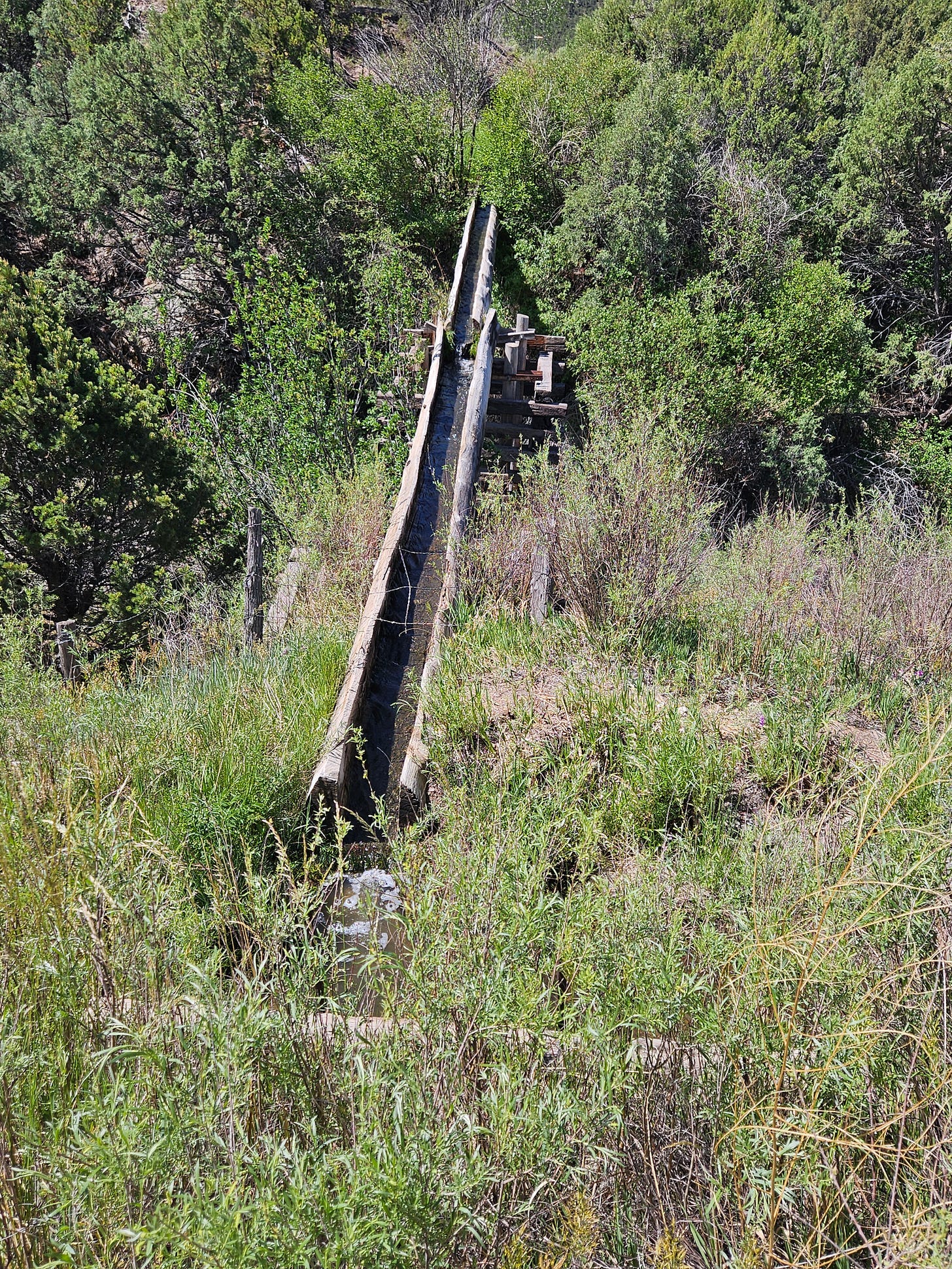
This picture shows the water flowing over a gully in a canoa, of flume. Photo John Lovie Like the indigenous settlements before them, the Spanish settlements were along the line where the mountain streams reach the alluvial plain.
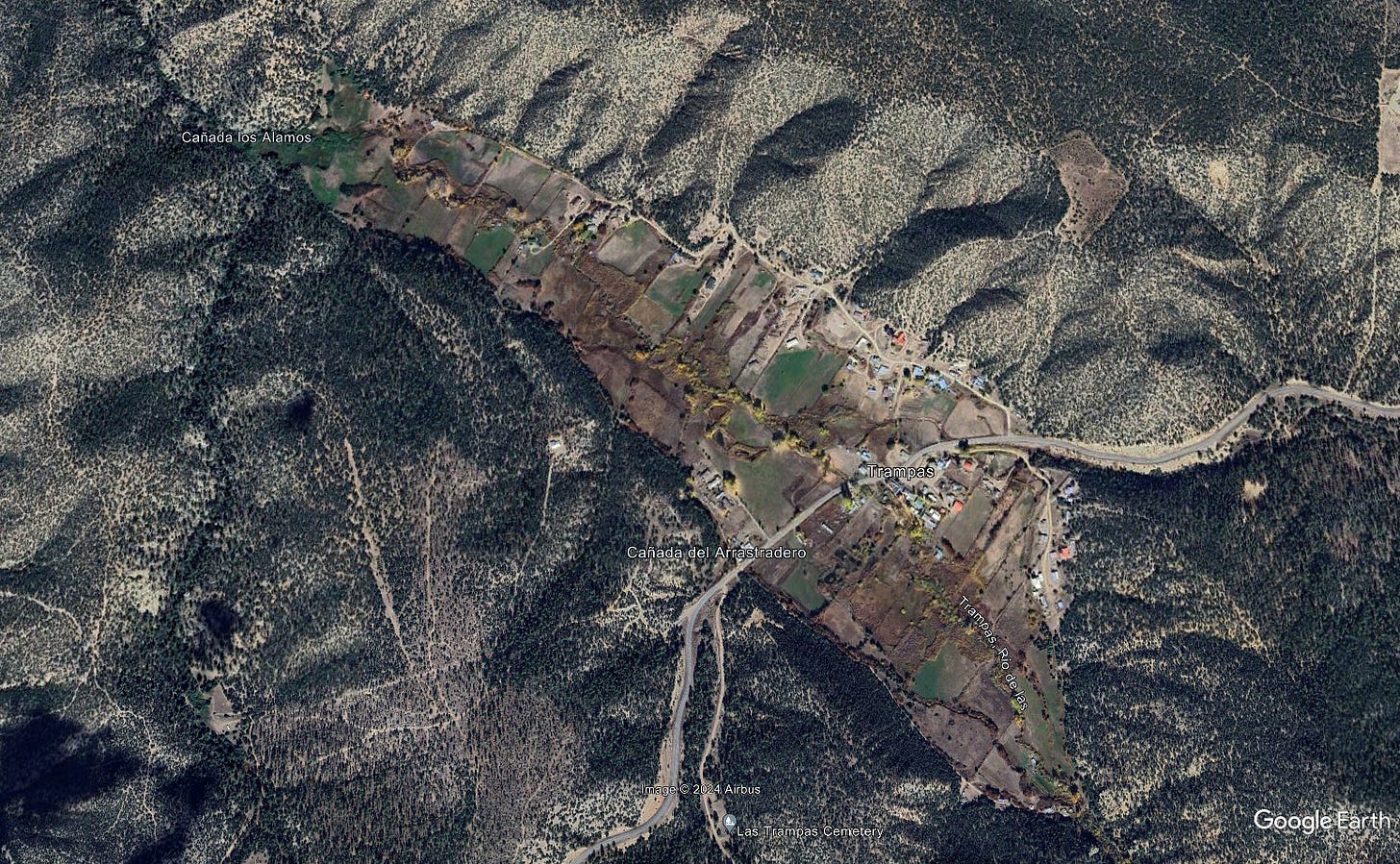
This aerial view of Las Trampas shows the area irrigated by the acequia. Here’s a video which talks about the communal maintenance of these acequias.
Dams
Following passage of the National Reclamation Act in 1902, the Federal Government began constructing dams and irrigation canals across the arid west, including on the main stem of the Rio Grande in New Mexico, eventually leaving it severely taxed.
Here in the Rio Grande watershed, the last thing I expected was to write another story about the Colorado river. The Colorado River compact allotted New Mexico 11% of Colorado River water, as the San Juan River, a major tributary, runs through the northwestern corner of the state. Most of the need was in the two thirds of the state east of the continental divide, in the Rio Grande watershed. And so, as part of the New Deal, the Bureau of Reclamation conceived of the San Juan – Chama project. This would take water from tributaries of the San Juan River and divert it through a tunnel under the state line, the continental divide, and under us, as we drove along US route 64, to Willow Creek, a tributary of the Chamas River, in turn a tributary of the Rio Grande.
Conceived in the thirties as part of the New Deal, the project would not be completed until 1960. On completion, the Bureau of Reclamation needed to apportion the water among the users in the Rio Grande basin. We’ll take a more detailed look at a couple of those users.
Santa Fe water
As detailed in this excellent Story Map:
In 1995, the City of Santa Fe purchased the water system from the Sangre De Cristo Water Company and the water utility became a public resource. At this time, water use and demand were at an all-time high.
Since 1995, the City of Santa Fe has worked to recover from groundwater mining, reduce water consumption, and plan for the future to ensure this precious resource will be available for future generations. To achieve this, Santa Fe relies on water conservation to reduce demand and use of renewable surface water when available so that groundwater supplies continue to be replenished for periods of drought.
Even with reduced snowpack and other climate impacts, the city expects its water supply to remain sustainable.
Taos Pueblo water
The water situation around Taos Pueblo is more complicated. Part of the problem is that the indigenous irrigation systems, the acequias, and the twentieth century additions, use very different and largely incompatible systems of water rights and governance, for example from History: The Politics of Water:
Thus began the long process of compromise, accommodation, and assimilation that was needed to produce a body of water policy suited to both the land and its many varied cultures. But the spirit of reluctant compromise did not completely erase the racial bigotries inherent in American culture. If white Americans in New Mexico found it necessary to incorporate aspects of the acequia system into their approach to water, they would change it to suit their worldview. One aspect of the acequia system that many white American leaders found offensive concerned the mayordomo. The mayordomo served as both local administrator and as a sort of water sheriff, whose duties included distributing water and commanding the mandatory labor of community inhabitants. To people raised on the rhetoric of independence and individualism, the mayordomo represented the worst aspects of a social system in which a few rich land owners lorded over an ignorant, dark-skinned peasantry. In 1895, the New Mexico territorial legislature dealt the traditional role of the mayordomo a deathblow by transferring his powers to ditch commissioners – a nod in the direction of science and efficiency. By the turn of the century, the entire acequia system would come under attack.
The Taos Pueblo Water Settlement began as a negotiation between Taos Pueblo and the Taos Valley Acequia Association (TVAA).
The TVAA represented 55 acequias and community ditch associations with approximately 7,000 individual irrigators in the Taos Valley. The negotiations grew to include the Town of Taos, the El Prado Water and Sanitation District, twelve Taos area mutual domestic water consumers’ associations (all representing another 11,000 Taos Valley residents), and the state and federal governments. By 2003, the negotiations had progressed far enough that the parties brought in a professional mediator to help them reach a settlement.
The Bureau of Reclamation carried out a thorough groundwater study to inform the settlement. In the end, the agreement allowed almost all existing uses of water and established guidelines for future use as well as a framework for settling disputes. Elinor Ostrom would be proud!
Northern New Mexico provides a fascinating and hopeful look at water infrastructure over the centuries and across different governance structures.
Coda
Since our return, New Mexico has been hit by fires, dust storms, and heavy rain and hail on the burn scar areas leading to flooding and debris flows. ‘Multiple disasters all in one day’: New Mexico’s brutal week of fire and flood | New Mexico | The Guardian. Nature reminds us that life under climate change in the arid southwest will only get more precarious.
Thanks, as always, for reading of listening.
-
‘Not a finish line’: For water providers, new PFAS rule is first step
‘Not a finish line’: For water providers, new PFAS rule is first step | HeraldNet.com

Houses are nestled on the hillside above Harrington Lagoon, downhill from a water well that for over a year has tested positive for PFAS on Thursday, June 22, 2023, in Coupeville, Washington. (Ryan Berry / The Herald) The EPA’s new rule only applies to water suppliers that serve 15 or more residents, known as “Group A” water systems. At least 1 million Washington residents have private wells or use smaller water suppliers, called “Group B” systems.
The Safe Drinking Water Act doesn’t protect these wells, some of which are near Harrington Lagoon. Those wells also likely have PFAS contamination, Lovie said.
“They’re not eligible for any of the loans or grants that Group A water systems can get to take care of these problems,” he said. “They’re not subject to requirements for testing for PFAS.”
Lovie and officials with Ecology — who have been tracking PFAS for years — said the EPA’s rule is a milestone in addressing drinking water contamination. But it’s only the first step in organizing funding, testing and cleanup efforts for the large and looming PFAS problem.
“This is not a finish line,” Lovie said. “This is a starting line.”